Biblical conspiracy theorists hypothesize about the identity of the "revived Roman Empire" who will host the Antichrist during end times or something like that.
I'm not getting into that.
Many different currents flowed into the ideological stream of the American Founding. The Greco-Roman current is unquestionably one of them. Though much emphasis needs to be added to the Roman part, especially the Stoic philosophy of those noble ancients.
Though I haven't read the book yet, Jeffrey Rosen's new book seems like one that will shed some much needed light on this particular dynamic.
Set all of the conspiracy nonsense aside, one thing America's Founders explicitly seemed intent on was "reviving" not the evil Roman Empire of Caesar's tyranny, but rather that of the noble Stoic Roman Republicans whom those tyrannical Caesars wiped out.
But yes, understandably, for their time, what America's Founders did was "new" and thus in some meaningful way "different" than the ancient system that so inspired them.
Friday, February 23, 2024
America: The Revived Roman Republic
Friday, February 16, 2024
Observations on Senator Josh Hawley's Christian Nation Piece Part II
See Part I here.
More from Sen. Hawley:God gave rulers authority to command and coerce, but only insofar as they protected the liberties of the people. God instructed the people, in turn, to obey “the governing authorities” (Romans 13:1), but only insofar as the rulers honored their liberties. Winthrop envisioned a covenant made with God: Only a godly nation would win God’s favor and prosper under his direction of human affairs. But the political covenant was also—and this is crucial—an agreement between the rulers and the ruled. Should the authorities break the terms of God’s delegation of governance and assault the people’s freedoms, then the people had a right to defend themselves, even to rebel.
I emphasized what is in bold. This is an extremely loaded and contentious understanding of Romans 13. Great Britain, against whom America rebelled was every bit as "Christian" and "biblically informed" as America was and their political pulpits didn't understand Romans 13 with these qualifications. Arguably their understanding was the more "fundamentalist" in terms of a "literal" reading of the verse and chapter.
More from Hawley:
It is a small step from covenants to constitutions, and if this rehearsal of the evolution of early modern political thought brings to mind John Locke, it should. Locke learned covenantal theory from the French Calvinists and converted it (sometimes dubiously) to his own use. Thus, whether from the Puritan settlers or from the Calvinist-influenced Locke, covenant has long been in the American bloodstream. ...
There is precisely zero evidence that Locke learned covenantal theory from the French Calvinists. The American Founding had many different currents that flowed into its stream and the "Calvinist resisters" (as I like to call them) were certainly one of them. Locke was a much stronger current and he has nothing to do with them. There is a provable connection between Locke and Hobbes (and the Anglican divine Richard Hooker).
Locke's teachings complete with the "state of nature/social contract and rights" (what he got from Hobbes) did find their way into the founding era "political sermons." But whether such teachings are in according with traditional Christianity is entirely debatable.
More from Hawley:
I have attempted only the barest sketch of the Bible’s influence on America’s most enduring ideals. Others have traced the argument in greater detail. Larry Siedentop’s Inventing the Individual: The Origins of Western Liberalism demonstrates the Christian taproot of Western rights. In The Hebrew Republic: Jewish Sources and the Transformation of European Political Thought, Eric Nelson identifies the biblical ground of our political institutions. There is real value in getting this history right, because it tells us what sort of society America has truly been. ...
I'm not familiar with Siedentop's work (though I hope one day to be), but am intimately familiar with Nelson's. Yes it's a work that all interested in this topic should check out. I'm not sure whether Hawley fully understands or accurately represents it in his brief mention. Nelson's thesis does not focus on America but rather prior European (it's in the title of the book!) writers (many of whom indeed did influence America's founders). And he connects their thought to all of the nations (mainly Western) that comprise "modernity."
Nelson's work focuses on one group of thinkers -- the "republicans" -- in contrast to the "liberals." Madison's excerpt from Federalist 10 that I featured in Part I well represents the "liberal" perspective. And Madison's liberal view is in tension with the "Hebraic republican" view.
The bottom line is this: Madison didn't believe in limits on the accumulation of and the consequent redistribution of wealth. But the Hebraic republicans did. Indeed someone from the "Christian Left" who believe in such would find much ammo for their perspective in Nelson's book.
Something else notable about the Hebraic republicans featured in Nelson's book is the content of their theology. I'm no theologian, so I'm not one to judge. But for those looking for "sound theology" you really need to question their hermeneutics and exegesis. In short, they argued that the Old Testament taught "republican" form of government that demanded redistribution of wealth in the form of "agrarian laws." (They thought the way the OT dealt with debt and the Jubilee was an agrarian law.)
The way I see it, the concepts of "republican" government and "agrarian" laws have nothing to do with the Old Testament. But these thinkers (James Harrington of "Oceana" fame is one of the most notable) argued otherwise. I see them as grafting on post-hoc these Greco-Roman principles to the Old Testament.
Also note when the authors of the Federalist Papers discussed the concept of republican government precisely NONE of the Hebraic republican rhetoric was invoked. It was mostly Greco-Roman metaphor (just look that their surnames like Publius).
A final point of analysis. More from Hawley:
... But the nation’s ideals, social institutions, and habits have all been Christianly shaped. And this is a good thing, maybe especially for Americans who are not Christians. Precisely because of the Christian influence, American society has protected the liberty of all to speak, to worship, to assemble and petition, to share in self-rule.
A little while ago, Hawley stepped in it by spreading a phony quotation attributed to Patrick Henry:
“It cannot be emphasized too strongly or too often that this great nation was founded, not by religionists, but by Christians; not on religions, but on the Gospel of Jesus Christ. For this very reason, peoples of other faiths have been afforded asylum, prosperity, and freedom of worship here.”
The actual quotation came from 1956 in a magazine called The Virginian. It was from an article about Patrick Henry. It is good that Hawley doesn't repeat the error in this article. Though I do note that Hawley's sentiment seems influenced by the commentary from The Virginian. (No, it's not plagiarism; I'm just noting the apparent influence.)
Thursday, February 15, 2024
Observations on Senator Josh Hawley's Christian Nation Piece Part I
... The Founders read Roman historians, yes. Some were influenced by Enlightenment philosophies. But the Bible has been the main source of our national ideals. From the age of the New England Puritans to the Great Awakening that prepared the ground for revolution, Scripture has molded our common life from the first. Consider: Our ideal of the individual has Christian roots. So too does our constitutionalism. Our great traditions of progressive reform were animated by an ardent Christian spirit—as was conservative resistance to their excesses. Even in our most bitter conflicts, Christian culture has been America’s common ground.
The term "national ideals" is amorphous political speak. I think where his claim is at its strongest is that Christianity was important at the cultural, local, decentralized level. Where it's at its weakest is that the ideas are responsible for the Declaration of Independence and US Constitution. One thing I do appreciate about the claim is that it (properly) intimates there are various ways of understanding the faith. A "Christian Left" for the progressives and a "Christian Right" who resist.
But what we will then see is that his idealized politics ends up "coloring" his theological understanding of Christianity, in "questionable" ways. His history likewise is cherry picked and idealized.
Next passage:
Conservatives have their own version of the secular myth, one that usually comes with appeals to the market or James Madison or both. Some conservatives—the neoliberal types—argue that free-market exchange supplies all the common meaning we will ever need. We can unite in the cause of moneymaking, they say. But you don’t need a society for that. Corporations and trading zones will suffice. Other conservatives look to the Constitution for salvation, as if that document were a perpetual motion machine that can operate on its own, no common affections or moral purpose needed. Set faction against faction and the republic will endure forever! But Madison never said any such thing. He presumed a baseline of shared culture, language, and moral outlook—a very robust baseline, by modern standards. The truth is that no constitution, however well designed, can unite a people who do not hold a common conception of the good. No system of checks and balances can replace a common moral vision.
I will let people read Madison's Federalist 10 to which was above alluded. Hawley puts words into Madison's mouth he never said, but on "set[ting] faction against faction," THIS is what Madison said:
By a faction, I understand a number of citizens, whether amounting to a majority or a minority of the whole, who are united and actuated by some common impulse of passion, or of interest, adversed to the rights of other citizens, or to the permanent and aggregate interests of the community.
There are two methods of curing the mischiefs of faction: the one, by removing its causes; the other, by controlling its effects.
There are again two methods of removing the causes of faction: the one, by destroying the liberty which is essential to its existence; the other, by giving to every citizen the same opinions, the same passions, and the same interests.
It could never be more truly said than of the first remedy, that it was worse than the disease. Liberty is to faction what air is to fire, an aliment without which it instantly expires. But it could not be less folly to abolish liberty, which is essential to political life, because it nourishes faction, than it would be to wish the annihilation of air, which is essential to animal life, because it imparts to fire its destructive agency.
The second expedient is as impracticable as the first would be unwise. As long as the reason of man continues fallible, and he is at liberty to exercise it, different opinions will be formed. As long as the connection subsists between his reason and his self-love, his opinions and his passions will have a reciprocal influence on each other; and the former will be objects to which the latter will attach themselves. The diversity in the faculties of men, from which the rights of property originate, is not less an insuperable obstacle to a uniformity of interests. The protection of these faculties is the first object of government. From the protection of different and unequal faculties of acquiring property, the possession of different degrees and kinds of property immediately results; and from the influence of these on the sentiments and views of the respective proprietors, ensues a division of the society into different interests and parties.
The latent causes of faction are thus sown in the nature of man; and we see them everywhere brought into different degrees of activity, according to the different circumstances of civil society. A zeal for different opinions concerning religion, concerning government, and many other points, as well of speculation as of practice; an attachment to different leaders ambitiously contending for pre-eminence and power; or to persons of other descriptions whose fortunes have been interesting to the human passions, have, in turn, divided mankind into parties, inflamed them with mutual animosity, and rendered them much more disposed to vex and oppress each other than to co-operate for their common good. So strong is this propensity of mankind to fall into mutual animosities, that where no substantial occasion presents itself, the most frivolous and fanciful distinctions have been sufficient to kindle their unfriendly passions and excite their most violent conflicts. But the most common and durable source of factions has been the various and unequal distribution of property. Those who hold and those who are without property have ever formed distinct interests in society. Those who are creditors, and those who are debtors, fall under a like discrimination. A landed interest, a manufacturing interest, a mercantile interest, a moneyed interest, with many lesser interests, grow up of necessity in civilized nations, and divide them into different classes, actuated by different sentiments and views. The regulation of these various and interfering interests forms the principal task of modern legislation, and involves the spirit of party and faction in the necessary and ordinary operations of the government.
This does resonate with the notion of setting factions against one another in a pluralistic, commercial republic. So maybe the conservative (or "neoliberal") "secular myth" has something to it at least with regards to Madison.
More from Sen. Hawley:
... The Romans prized property rights—for certain people—and the Greeks and Romans both praised the liberty of the citizen to share in ruling the city, but the advent of individual liberty accompanied by personal rights awaited the New Testament’s announcement of freedom in Christ. “For freedom Christ has set us free,” the apostle Paul announced. This was deeply personal freedom of a radically new kind.
I think it's a fair point to credit Christianity for laying a fertile ground for the concept of individual liberty, which as Hawley accurately notes, "[t]he West would spend centuries working out its implications," but it's simply mistaken or bad theology to attempt to credit Paul in these passages for preaching political liberty. That would come much, much later. The "centuries." Paul noted this in the context of also telling slaves to obey their masters, after all.
More from Sen. Hawley:
... The Ten Commandments (for example) are moral duties, to be sure, but they also adumbrate individual rights. They define the obligations of individuals, which entail the political freedoms individuals must enjoy in order to meet them. Over time, Christian theorists would come to see that God’s injunctions require the rights to worship, to marry, to pursue an honest profession, and to live generally in a manner pleasing to the Lord.
The term "over time" is what saves this passage. Yes, it took a long time. Any honest reading of the Ten Commandments though, reveals a tension with these freedoms, even if they are ultimately reconcilable from a Christian and biblical perspective. America's Founders were clear that the "rights to worship" applied universally, not just to Christians. This includes the inalienable right to break them by worshipping what some might see as false gods.
More from Sen. Hawley:
Then there is constitutionalism, another Christian contribution to our nation’s identity. On board the Arbella as it was sailing for a new world, John Winthrop told his fellow colonists that they were making a covenant with God; they would be a “city upon a hill,” a light to all the world, a community committed to God’s law. Winthrop came by the idea of covenant naturally. Christians had been reading it in their Bibles for centuries. God made a covenant with Noah, and then with Abraham, and then with Moses and David after them. The God of the Bible was a covenant-making God. By the 1600s, Christian theorists had come to explain God’s purposes for government in terms of covenant.
I'm of the mind that America was "founded" in 1776, not 1619. The period to which Hawley refers was when America was actually Great Britain. These covenants were also done prior Britain's own Glorious Revolution (which led them in a more democratic-republican direction) and were explicitly done under the doctrine of the Divine Right of Kings, one thing against which America especially rebelled.
Wednesday, July 19, 2023
How Dr. Waligore Categorizes Different Theologies
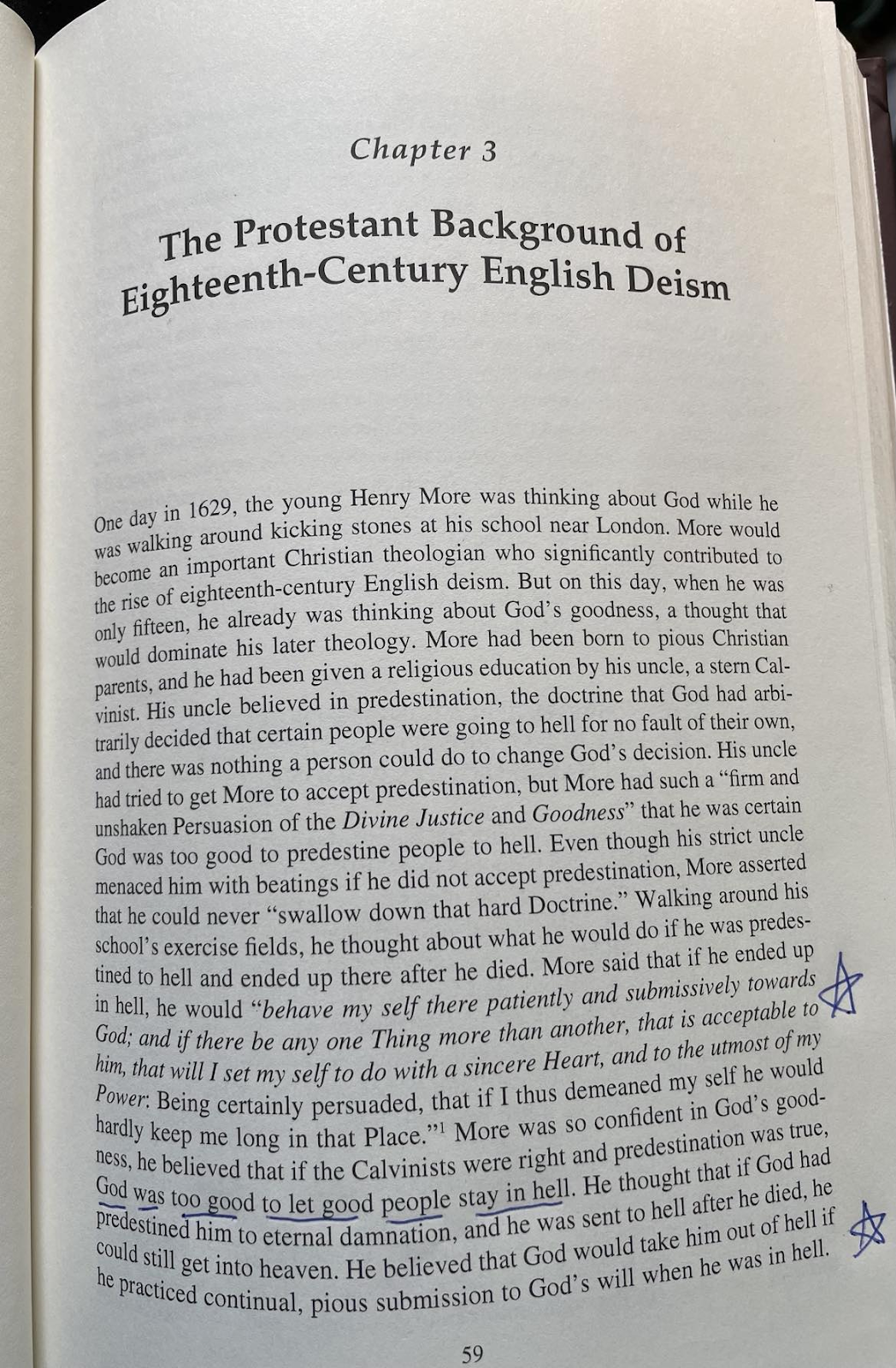

This post is intended to be a brief overview of Dr. Joseph Waligore's new book on deism. I plan on having much more to say, but in this post, I try to hit some main points.
Waligore observes and constructs a number of different theological categories in his analysis to compare and contrast with the theology of deism. "Christianity" generally requires belief in orthodox Trinitarian doctrine and authority of the entire Bible (it's mainly Protestant Christianity that is being analyzed, so it would be the 66 book Protestant canon).
There is one kind of "traditional Christianity" that, for lack of better words, is neither "freethinking" nor "ecumenical" on doctrine and dogma. Even though many more than two traditions within Christianity could be invoked to serve this purpose, it's mainly Calvinism and High Church Anglicanism that serve as useful guideposts in his book. (Though other forms, like Arminianism are also analyzed.)
Waligore observes the voyage of (Protestant) Christianity to Deism, by noting two OTHER Christian traditions that in the 17th Century started to engage in "doctrinal freethinking" for lack of a better term. The Cambridge Platonists and the Latitudinarians (the name refers to "latitude" on matters of doctrine). Though the reason why they merit the label "Christian" is again, they tended to endorse orthodox Trinitarian doctrine and the authority of the entire Bible.
One potential point of criticism is as much as we want figures to neatly fit into different "boxes" that we construct for a better, more accurate understanding, is that people often don't neatly fit into those boxes. For instance, Samuel Clarke gets put in the "Latitudinarian" not "Unitarian" box; though arguably he could fit into either one. The boxes tend to bleed into one another.
But the pages I included in the photos on the Cambridge Platonists illustrate such freethinking (many of them seemed to flirt with some kind of modified universalism, and belief that human souls pre-existed and exercised their will prior to their physical birth, among other things). Yet, they remain "Christian" because, again, they claimed their heterodox ideas didn't contradict either the Bible or the doctrines of the Church of England.
By the time we get to the Unitarians, they lose the label "Christian" because of their disbelief in the Trinity. But Waligore stresses that they tended to have more respect for the entire Bible than the deists did.
And that sets the stage for an intense, meticulous analysis of the various forms of deism. And the chief message of this book is that while there are certain points that can be drawn to form a "deist" creed, belief in a non-intervening watchmaker God was actually a minority belief among the deists. Deism came in many varieties and most of them believed in a Providential God. And for those who did believe in Providence, they much more freely "picked and chose" what parts of the Bible they thought legitimately revealed and which parts they thought not.
Waligore also stresses that while the deists in general venerated man's reason as a discerner of truth, the notion that God was ultimately benevolent was the primary lens through which they viewed theology. Anything part of traditional Christianity or any other creed that they deemed made God look less than perfectly benevolent was cast aside.
Tuesday, July 18, 2023
Dr. Joseph Waligore's New Book on Deism
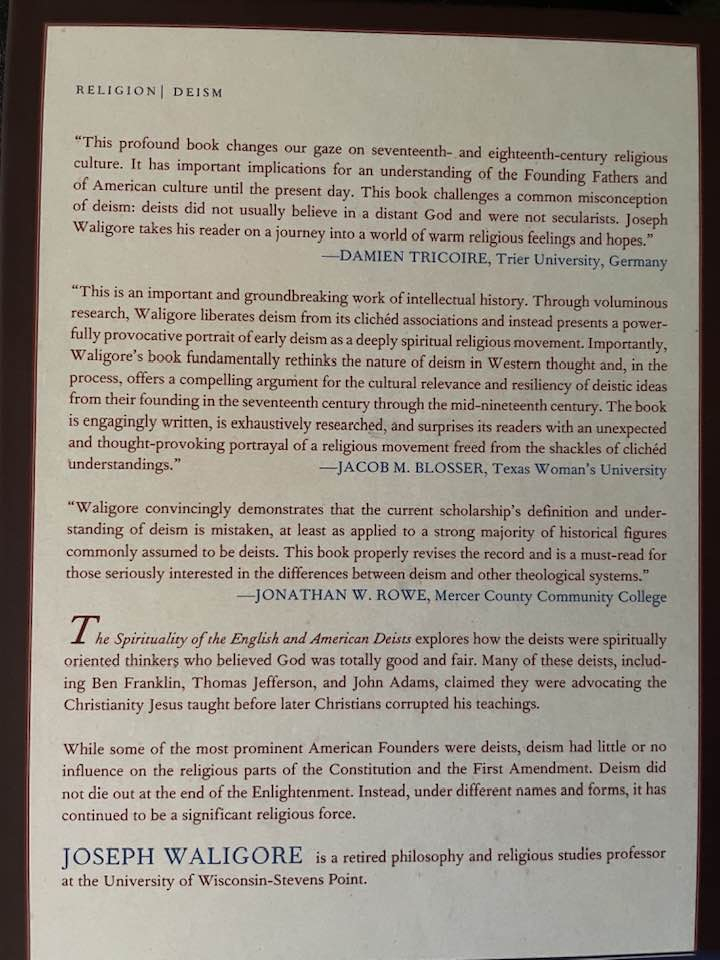
I've been absent from blogging for a few months because of a busy work-life (better to be busy than not!), but I've been planning on writing a great deal on this book by Dr. Joseph Waligore, in part because he closely reads our American Creation blog and our research has influenced the contents of this book.
I plan on having a lot more to say on the contents of this book; but it is a true "game changer" on how to understand the definition of "deism." Now, the current scholarly consensus defines deism as belief in 1. a non-intervening cold, distant watchmaker God who; 2. issues no special revelation, performs no miracles, doesn't communicate to man and consequently to whom praying would be a waste of time.
Waligore demonstrates that this definition is mistaken. Now, it's possible that because of how terms are understood in academic and other discourse, that we are "stuck" with this definition for now. However, keep in mind then that many of the historical figures whom we associate with "deism" from Washington, Franklin and Jefferson to Robespierre and many other figures of the French Revolution were not "deists." We need either a different term, or we need to qualify the term "deist" with an adjective like "warm deist," "providential deist," "Christian-Deist" etc., etc.
Friday, April 21, 2023
The American and French Revolutions: Locke, Calvin and Hobbes
A short time ago I briefly engaged an author who wrote a book on Christianity and the American Founding that purported to "defend" America in a "trial" sense of the term. I only engaged him on one point. It was about Hobbes, Locke, and Rousseau and their respective understandings of "the state of nature." We didn't even get to Rousseau, rather it was just the relationship between Hobbes and Locke.
I kept the conversation brief because I didn't feel like going down the Straussian rabbit hole with him (other people are doing that with him). And he was just trying to "shoo away" a fly. He said something to me like (me paraphrasing from memory, not necessarily an exact quote) "Locke's state of nature had nothing to do with Hobbes'." Yes, the A has nothing to do with B is an effective arguing technique. But in his case, it's simply not true. The concept of "the state of nature" itself, regardless of whether Hobbes, Locke, and Rousseau's all differ on it, connects them to one another. This was the "low but solid" modern ground on which the three of them argued and differed and on which modern liberal democracies were built. As of course, Leo Strauss observed.
I have noticed a tendency among social and religious conservatives who wish to defend America's Founding as "Christian" to overly attempt to distinguish America's Revolution and Founding from the French Revolution. Yes, the two events differed in meaningful ways. But also yes, the two events were connected at a deep level. They were viewed by America's founders as "sister events," at least at the very beginning before things started to go terribly wrong in France. France after all was key in securing America's victory from Great Britain.
John Locke greatly influenced America's Founding. But, there were other influences as well. John Locke and the America's Revolution influenced the French Revolution. But there were other influences as well. Influences that didn't take hold in America (Rousseau).
But let's turn our focus onto Locke, because he influenced BOTH the American AND French Revolutions. As noted above there is an "inside baseball" debate about how much Locke was "esoterically" influenced by Hobbes. We all agree that America followed Locke and its Founders had nothing positive to say about Hobbes.
But this is what I don't get about the conservatives who wish to separate Locke from Hobbes (and Hobbes, by the way, claimed to be a "Christian" too, just as Locke did): Locke's understanding about human nature (with his Tabula Rasa and "state of nature" teachings) seemed really naïve and Hobbes' much closer to the reality of what it looked like in caveman times when the Alpha males brutally ruled over the tribes. And that's where we humans derive our DNA.
On the US Constitution, James Madison made CLEAR in Federalist 55 that "there is a degree of depravity in mankind which requires a certain degree of circumspection and distrust: So there are other qualities in human nature, which justify a certain portion of esteem and confidence."
Note, even though there was a strong "Calvinist" component (with the other components) to the American Founding, this does NOT, in my opinion, reflect John Calvin's "Totally Depravity" of human nature. But rather a "Partial Depravity."
France (and Jefferson would go for this) left this out of the equation and took the Tabula Rasa from Locke.
Sunday, April 02, 2023
The Bogus Patrick Henry Quotation
First off, I'd like to thank "Rational Rant" for alerting me to this. I've long known that the below mentioned Patrick Henry quotation is fake; but only recently figured out the origin.
I know that in the past I may have been overly harshly critical of folks making "Christian nation" claims. I'm consciously trying to tone done my rhetoric and be more civil because I don't like how divided the country is and "Christian nationalism" is part of that division.
Tuesday, March 21, 2023
Denominational Affiliation Tells Us Little
I recently was involved in a discussion where, alas, the name of David Barton came up. At this point, I think Barton is a distraction from the issues that interest us on religion and the American Founding. I prefer not to talk about him but move on to better things. If he writes another baboon like "The Jefferson Lies," I will cover it. But otherwise I'm no longer interested.
But I do want to note something I think important. Gregg Frazer wrote a critique of Barton's "America's Godly Heritage" found here. Let me quote from it:
Let us begin with monumental unsupported assumptions presented as fact. The video begins with the claim that 52 of the 55 delegates at the Constitutional Convention were “orthodox, evangelical Christians.” Barton does not supply any source or basis for this astounding claim, but I strongly suspect that the source is M.E. Bradford’s A Worthy Company. It is, to my knowledge, the only “study” that attempts such a determination and that produces 52 as a result. The extent of Bradford’s evidence is simply a list of the denominational affiliations of the 55 delegates. Mere affiliation with a denomination is, of course, no evidence whatever of “orthodox, evangelical” Christianity. This is particularly true since, in order to get to 52, one must include the two Roman Catholics. If mere denominational affiliation is proof of orthodox Christianity, one must also wonder why Barton is concerned today, since 86% of today’s Congress is affiliated with Protestant or Catholic denominations (compared with just 75% of the national population). Today’s Congress is apparently more “Christian” than the American public.
Frazer's point speaks for itself; but let's also note who the three supposed "deists" were: James Wilson, Ben Franklin, and Hugh Williamson. Now, none of these three "fit" the definition of "deist" that most scholars posit. Though, all three perhaps were heterodox "Christian-Deists"/unitarians/theistic rationalists of some sort. Mark David Hall convincingly argues Wilson's views were in accord with orthodox Christianity (but personally I don't see the smoking gun evidence that Wilson was an orthodox Christian).
But the larger point I wish to make is Bradford's notion is largely worthless. Denominational affiliation proves very little. Thomas Jefferson who rejected every single doctrine of Christian orthodoxy was not only affiliated with the Anglicans-Episcopalians, but was at one point a vestryman in said church. Moreover, all 55 of the delegates arguably could be proven to have such affiliations.
Look, this is an intense debate subject to the most rigorous of scrutiny. And "both sides" equally share a burden of coming forth with smoking gun evidence to demonstrate their contentions. We've put "the key Founders" under the microscope and have found evidence of the heterodoxy of Jefferson, J. Adams and Franklin. And also good reason to believe Madison, Washington and Hamilton (before his end of life conversion) were not orthodox Trinitarians either. Further, we've found evidence of orthodoxy for such figures as Sherman, Jay, and many others.
But, there are plenty of lesser figures whom we simply haven't looked at in such intense detail. And it's wrong to assume one way or the other that they were orthodox Christians or some kind of unorthodox deists. Again denominational connection proves very little. Take for instance, George Clymer (who died in my zip code, lol).
Admittedly, I haven't studied the man in much detail. But this is taken from a site that seems sympathetic to the "Christian America" perspective. Let me quote it (and note, I haven't verified these details):
Religious Affiliation: Quaker, Episcopalian ?
Summary of Religious Views:
Clymer's father was Anglican. His mother had been raised as a Quaker, but she was rejected from that faith for marrying a non-Quaker. Because both his parents died when he was very young, Clymer was raised by Quaker relatives, but it appears that he did not become a Quaker himself, since his wife was disowned by the Quakers for marrying him. In general, religion seems not to have played much of a role in Clymer's adult life. At his request, Clymer's body was interred in a Quaker burial ground.
This doesn't sound like much of an "orthodox evangelical Christian" to me. But we do see the nominal connection to the Quakers and Anglicans.
Friday, February 03, 2023
Rubin on George Washington's Approach To the "Christian Nation" Question
Writing at the Washington Post, Jennifer Rubin has an article entitled, "Think America Is A ‘Christian Nation’? George Washington Didn’t."
I saw this from Dean Paul Caron's site. Quoting Rubin from Caron's site:
The Jewish community in the United States is as old as its democracy. In August 1790, George Washington sent a letter to the Hebrew Congregation in Newport, R.I., thanking them for their well wishes.
He wrote: “The Citizens of the United States of America have a right to applaud themselves for having given to mankind examples of an enlarged and liberal policy — a policy worthy of imitation. All possess alike liberty of conscience and immunities of citizenship.” He added, “It is now no more that toleration is spoken of as if it were the indulgence of one class of people that another enjoyed the exercise of their inherent natural rights, for, happily, the Government of the United States, which gives to bigotry no sanction, to persecution no assistance, requires only that they who live under its protection should demean themselves as good citizens in giving it on all occasions their effectual support.”
To a people long denied citizenship in the Old World, kept as a people apart from Christian neighbors, Washington was explaining something quite revolutionary: The United States does not simply forbear Jews; Jews are part of the United States. As the Touro Synagogue in Newport explains on its website: “The letter reassured those who had fled religious tyranny that life in the new nation would be different, that religious ‘toleration’ would give way to religious liberty, and that the government would not interfere with individuals in matters of conscience and belief.” ...
Those who view the United States as a “White Christian nation” would do well to ponder Washington’s letter. Its closing passage, which speaks in terms familiar to the people of the Torah, stands as an eloquent rebuke to that notion: “May the children of the stock of Abraham who dwell in this land continue to merit and enjoy the good will of the other inhabitants — while every one shall sit in safety under his own vine and fig tree and there shall be none to make him afraid.”
The Founding Fathers are often criticized (or excused) on matters of race and gender as men trapped in the blinkered vision of the past. But in this case, the most esteemed American of his time plainly saw beyond the common prejudices of his era. For that reason, he earned a special place in the hearts of American Jews. ... We Jews will remain part of the American experience so long as Americans of whatever faith or no faith heed Washington’s admonition.
Let me add, that some may claim, okay let's use "Judeo-Christian" instead of "Christian." But I have evidence that Washington viewed Islam as a legitimate monotheistic, non-Christian religion along with Judaism.
Friday, December 16, 2022
Samuel Seabury Leverages The Church of England into Communion With American Episcopalians
If it's fair to even call it "communion."
If we want to understand the political theology of the American founding and its attendant religious liberty and establishment issues, we need to understand the dynamic of how The Church of England (Anglicans) dealt with the separation.
The "official rules" of the Church of England held that the Monarch was head of both Church and State. The top clerical official is the Archbishop of Canterbury, who "reports" to the Monarch. If one did not affirm the Monarch's rightful place as leader of the Church, one could face severe legal penalties from both the civil magistrate as well as Church canons, up to and including excommunication.
I've noted before the irony that so many of America's leading Founding Fathers were Anglicans, and what they technically did was rebel against the head of their Church. If they were "Anglican fundamentalist" (high church types who followed every single rule of the C of E down to the letter), they would have been Tories and submitted to the King, because that's what the Church officially taught.
But even in Mother England, high church Anglicanism of the "fundamentalist" variety wasn't the only game in town in the C of E, even if perhaps it prevailed. Even King George III, about whose personal religious convictions I'm not exactly sure, I seriously doubt was an "Anglican fundamentalist" (even though that theology benefited his self interest). I'm assuming "the Christian King" was some kind of orthodox Trinitarian Anglican (?); but the attitude of the Monarchy towards America, up until things got heated with their dispute seemed to be one of (as the late Sen. Daniel Patrick Moynihan put it in an entirely different context) "benign neglect."
The variety of Anglicanism that appealed to the Whig Patriots of the American founding was that of "low church latitudinarianism." Latitudinarianism literally means "doctrinal latitude." Now, most of these latitudinarians were probably "orthodox" on the Trinity and related doctrines; but not all of them. Or at least, their "doctrinal latitude" made room for more deistic and unitarian minded theists to feel comfortable in the Church.
If one wants a name of a latitudinarian figure that America's founders greatly respected, look up Bishop Benjamin Hoadly.
Over in America during the revolution, Bishop William White was concerned that the conflict would fracture the Church. And his concerns were valid. As a matter of technicality, the Church of England only had jurisdiction in England. If America is no longer England, then the Church of England no longer exists there, even if the buildings and believers remain. Many of the believers left. The revolution indeed gutted the C of E in America.
But when America successfully rebelled, the C of E in America, by necessity had to "start over." The Anglican hierarchy in England no longer had any power or jurisdiction over America. Ultimately what ended up happening was because Bishops White and Samuel Seabury (and other Anglican power players in America) were committed to historic Anglican orthodoxy, what emerged in American Episcopalianism was something traditional and orthodox.
It didn't have to be that way though. In New England, one of the Anglican Churches, King's Chapel went unitarian after the split. Indeed, if Bishop James Madison whom many suspected was heterodox, got his druthers and was in charge of rewriting the rules for Southern Anglicans and got his cousin and namesake and Thomas Jefferson to assist, we could have had a Unitarian Episcopalian system there too.
But what of the issue of "communion" among American and English Anglicans, post revolution? The first American Bishop was Samuel Seabury, a Tory loyalist and "The Farmer" whom Alexander Hamilton purported to "refute." He was jailed during the revolution for his loyalism. But after America won, he wished to remain and help rebuild the C of E in America, now as The Protestant Episcopal Church.
Seabury traveled to Great Britain to get consecrated by the C of E. But he ran into a problem. The then extant rules officially demanded he take an oath of loyalty to the crown. Seabury wisely refused because he knew that wouldn't fly in America. But he got consecrated anyway by the Scottish Episcopal Church, composed of non-juring Bishops who "borrowed" from the Church of England's theology, but without recognizing any of their authority.
So at that time, Seabury was America's first and only existing Bishop and was in communion with a church that was in schism with the Church of England. This turned out to be a wise and strong move on Seabury's part. Great Britain ended up changing its rules to accommodate America's new situation. They apparently did NOT want American Episcopalians to be in communion only with the schismatic Jacobite Church.
So they relented and consecrated the next three American Bishops, William White, Samuel Provost and James Madison. In the Church of England. And I'm assuming without the "loyalty to the crown" oaths.
Friday, November 25, 2022
John Adams' FU Letter to Jedidiah Morse
Adams was a fervent theological unitarian who militantly and bitterly rejected the doctrine of the Trinity. In 1815, he gets a letter from one Jedidiah Morse who attacked unitarianism, which was then growing in popularity.
Adams responded with an FU letter featured that you can read in its entirety here. To his credit, Adams tries to occupy a reasonable middle ground between the Trinitarian Calvinist fundamentalist "orthodoxy" Morse was trying to enforce and the more radical philosophical deism that was in the "air" of that era.
When Adams uses the term "Athanasianism," he refers to the traditional Trinitarian orthodoxy of St. Athanasius who defended the Nicaean creed in 325AD against Arius (Adams was on Arius' side). Athanasius also later first (meaning he literally was the first early church father or figure to do so) articulated the 27 books of the New Testament as an exclusive list in 367 AD (something Adams mistakenly thought was done in Nicaea; and Adams didn't have any kind of confidence in the biblical canon partly because of such).
But on to Adams' quotation:
... More than fifty years ago, I read Dr. Clarke, Emlyn, and Dr. Waterland: do you expect, my dear doctor, to teach me any thing new in favour of Athanasianism? — There is, my dear Doctor, at present existing in the world a Church Philosophick. as subtle, as learned, as hypocritical, as the Holy Roman Catholick, Apostolick, and Ecumenical Church. The Philosophical Church was originally English. Voltaire learned it from Lord Herbert, Hobbes, Morgan, Collins, Shaftsbury, Bolingbroke, &c. &c. &c. You may depend upon it, your exertions will promote the Church Philosophick, more than the Church Athanasian or Presbyterian. This and the coming age will not be ruled by inquisitions or Jesuits. The restoration of Napoleon has been caused by the resuscitation of inquisitors and Jesuits.I am and wish to beYour friend,JOHN ADAMSQuincy, May 15th, 1815.
Friday, November 04, 2022
Revisiting George Washington and Richard Price
The minimal points are as follows: 1. devout belief in a warm Providence; 2. the importance of "religion" (generally defined) in helping to promote the morality of a virtuous citizenry on which republics depend; and 3. because "Christianity" is a "religion," a general endorsement of "Christianity" without necessarily endorsing orthodox Christianity's narrow claims.
I do NOT see Washington as a Trinity and Incarnation believing "orthodox Christian," but rather something else. But I would agree that there are ambiguities in the record (and, to me, they seem purposeful on Washington's part).
But it's in trying to "fill in" these gaps -- the "detective work" -- that leads to a temptation: To incorporate the words of other people and institutions and put them in Washington's mouth or at least into his personal convictions. So, Washington was an Anglican; and Anglicanism has spilled a lot of words on what it stands for. Let us then assume that this is what Washington believed. OR, Washington was a collector of sermons; let us then assume he believed in all the content of the sermons he collected. OR, Washington corresponded with various religious figures and organizations of his day and said nice things to them; let us then assume he agreed with them on all of their doctrinal points.
All of those assumptions I described above are problematic.
As I noted in my above mentioned 2008 post, one of the theologians that was the subject of Washington's brief correspondence was the legendary British Arian Richard Price. Price gave an "address" -- perhaps it could be classified as a "sermon" because Price was among other things, a minister -- entitled "Observations on the Importance of the American Revolution."
It is indeed only a rational and liberal religion, a religion founded on just notions of the Deity as a being who regards equally every sincere worshipper, and by whom all are alike favoured as far as they act up to the light they enjoy, a religion which consists in the imitation of the moral perfections of an almighty but benevolent governor of nature, who directs for the best all events, in confidence in the care of his providence, in resignation to his will, and in the faithful discharge of every duty of piety and morality from a regard to his authority and the apprehension of a future righteous retribution. It is only this religion (the inspiring principle of every thing fair and worthy and joyful and which in truth is nothing but the love of God and man and virtue warming the heart and directing the conduct) — it is only this kind of religion that can bless the world or be an advantage to society. This is the religion that every enlightened friend to mankind will be zealous to promote. But it is a religion that the powers of the world know little of and which will always be best promoted by being left free and open.
I cannot help adding here that such in particular is the Christian religion. ...
Now, Price's personal "Christian" convictions were, as noted above, Arian (the belief that Jesus, the Son of God, is NOT God the Son, but rather a created being who is higher than the highest angel, but not fully God Himself). Though, Price's address doesn't stress the Arianism (as I initially first thought when reading it).
Price does say the following:
Perhaps nothing more shocking to reason and humanity ever made a part of a religious system than the damning clauses in the Athanasian creed and yet the obligation of the clergy to declare assent to this creed, and to read it as a part of the public devotion, remains.
Again, Price was an Arian; the Athanasian Creed was a Trinitarian one that has "clauses" that "damn" people (like Price himself) for not believing in the Trinitarianism expressed there. However, other Trinitarian creeds, most notably the Nicene, were more central. Theologically unitarian Founding Fathers and their influences like Price often did use the term "Athanasian" as a shorthand for "Trinitarianism" (mainly because of St. Athanasius' role in defending the Trinity during the Council of Nicaea).
But in rereading Price's address, it seems more of an attack on that particular part of the Athanasian creed than promotion of theological unitarianism. Though, Price does describe the "latitudinarian" landscape of the Church of England at his time and how unitarians and other dissenters like himself "fit in" there:
The Church Establishment in England is one of the mildest and best sort. But even here what a snare has it been to integrity? And what a check to free enquiry? What dispositions favourable to despotism has it fostered? What a turn to pride and narrowness and domination has it given the clerical character? What struggles has it produced in its members to accommodate their opinions to the subscriptions and tests which it imposes? What a perversion of learning has it occasioned to defend obsolete creeds and absurdities? What a burthen is it on the consciences of some of its best clergy who, in consequence of being bound down to a system they do not approve, and having no support except that which they derive from conforming to it, find themselves under the hard necessity of either prevaricating or starving? No one doubts but that the English clergy in general could with more truth declare that they do not, than that they do, given their unfeigned assent to all and everything contained in the Thirty-nine Articles and the Book of Common-Prayer; and yet, with a solemn declaration to this purpose, are they obliged to enter upon an office which above all offices requires those who exercise it to be examples of simplicity and sincerity. Who can help execrating the cause of such an evil?
Bold face is mine.
"Latitudinarianism" means "doctrinal latitude." Not all latitudinarians were unitarian; but as I understand the record, some/many were. People part of the Church of England in Richard Price's day -- including ministers -- didn't necessarily buy into everything the Church "officially" taught.
Well, what does this have to do with George Washington?
For one, Washington endorsed Price's address. As he wrote to BENJAMIN VAUGHAN, February 5, 1785:
Sir: I pray you to accept my acknowledgment of your polite letter of the 31st. of October, and thanks for the flattering expressions of it. These are also due in a very particular manner to Doctr. Price, for the honble mention he has made of the American General in his excellent observations on the importance of the American revolution addressed, "To the free and United States of America," which I have seen and read with much pleasure.
So, it's also a mistake to cherry pick from the polite correspondence Washington had with more orthodox theologians and groups and assume that Washington personally shared their beliefs. Likewise, because Washington was affiliated with the Anglican Church, it's a mistake to assume he believed in all of their doctrines. If Washington were an Anglican fundamentalist, he'd be a Tory. And as we've seen above from Price's testimony, plenty of Anglicans, including ministers from that area "dissented" from or otherwise rejected "official" doctrine like that found in the Thirty-nine Articles and the Book of Common-Prayer.
As I look at the "big picture" I see Washington's personal creed as closer to Price's than that of the more traditional orthodox types of his day; however, even there, we have uncertainty. Washington could have been even further from conventional Christianity than Price was. He could have been more Socinian and Deistic (though, as noted above Washington clearly believed in a warm Providence).
Sunday, October 02, 2022
Arnold's Article on James Madison, Anti-Christian Nationalist
This is is very thorough and well argued article from a brilliant young scholar, Gordon Dakota Arnold. He sympathizes with the perspective of more accommodation of traditional, conservative Christianity in public life. The article is a good reminder that America's Founders weren't always on the same page. But we can make observations like James Madison and Thomas Jefferson had a particular vision of church-state relations that was more secular and "separation of church and state" oriented. This has been called the "Virginia view" because Madison and Jefferson were both from Virginia and saw their vision validated in the Virginia Statute for Religious Freedom.
But there were other perspectives; the "Massachusetts view" was most notably articulated by George Washington and John Adams and permitted more expression of religion in public life and more interplay between church and state.
But onto Arnold's article. A taste:
Was Madison a Christian?
It is quite likely that the beginning of Madison’s rejection of Christian nationalism is found in a rejection of orthodox Christianity more generally. Like George Washington, Madison was meticulous in his effort to keep his precise religious beliefs private, and he shied away from discussing theology or religious doctrine in all of his private correspondence. Whereas Thomas Jefferson and John Adams left ample evidence in their writings that they rejected the divine origins of orthodox Christianity, Madison’s papers never explicitly denounced doctrines such as the divinity of Jesus Christ or the resurrection.11 And yet, it is a mistake to rely upon arguments from silence as a means of bolstering Madison’s claims to orthodoxy. In 1774, when Madison the youth was studying under the Rev. John Witherspoon and considering a career in ministry, he praised the “advocates of the cause of Christ.”12 But after this, references to Jesus Christ in his private correspondence disappeared and he appeared to approach religion with more indifference. As an adult, Madison is said to have refused to kneel for prayer, and though he sometimes attended an Episcopal Church, he never joined it and never participated in holy communion.13 Friends of Madison, such as the Bishop William Meade, attested to his unbelief,14 and George Ticknor recounted a conversation he had with the President in 1815 wherein he “intimated to me his own regard for Unitarian doctrines.”15
But more disturbing than Madison’s apparent shift away from the evangelical theology of his youth is the sense one gets while reading his corpus that his final position entailed more hostility towards traditional Christianity than has often been acknowledged. As early as 1772, Madison included a striking note in his Commonplace Book, quoting from the Cardinal de Retz: “Nothing is more Subject to Delusion than Piety. All manner of Errors creep and hide themselves under that Veil. Piety takes for sacred all her imaginations of what sort soever.”16 Throughout Madison’s long career, he often returned to this theme about the political dangers of piety and religion. “Religious bondage,” he said to his friend William Bradford, “shackles and debilitates the mind and unfits it for every noble enterprize every expanded prospect” [sic].17 While Madison in one instance referred in passing to Christianity as the “best & purest religion,” it is likely that he, like his friend Thomas Jefferson, primarily praised it with a view towards its ethical precepts—precepts accessible to unaided, natural reason—and emphatically not its doctrinal claims uncovered within divine revelation.18 In fact, Madison thought that doctrinal orthodoxy needed to be eliminated in order to further the cause of progress and enlightenment. In a letter to Thomas Jefferson, Madison complained about “Sectarian Seminaries” in Virginia—almost certainly alluding to Calvinist or Reformed institutions of learning—and their incorporation into the Virginia state charter on the grounds that this would empower churches of “any creed however absurd or contrary to that of a more enlightened age.”19 Doctrines must shift and change with the times, and any attempt to ground the nation in a static doctrine of Christianity is a threat to progress.
[...]
Madison and the Great Divorce of Christianity and Politics
Because he believed that religion is essentially a passion that causes rather than discourages faction, Madison also contended that it needed to be pacified for liberty to be preserved. The primary method of solving the political problem of Christianity was to encourage religious diversity and foster disunity. As Madison’s friend, neighbor, and first biographer William Cabell Rives reported, the President was fond of quoting Voltaire’s maxim that “if one religion only were allowed in England, the government would possibly be arbitrary; if there were but two, the people would cut each other’s throats; but, as there are such a multitude, they all live happy and in peace.”30 And Madison himself left no doubt that these were exactly his sentiments. He spoke in Federalist no. 51 of how the “multiplicity of sects” was the only security for the preservation of “religious rights.”31 In a letter to Thomas Jefferson, Madison celebrated the fact that the “mutual hatred” of Virginia’s Christian denominations “has been much inflamed.”32 He added: “I am far from being sorry for it, as a coalition between them could alone endanger our religious rights.”33 Where the Apostle Paul spoke of the need for harmony, unity, and love within the body of Christ, Madison preferred that the church be characterized by disarray, discord, and faction. Only then would Christianity fail to mobilize itself as a political force, and only then would the natural rights of individuals be safe from a majority faction. Madison’s view, too, contrasts with the more Pauline beliefs of George Washington, who celebrated the “harmony and Brotherly Love which characterizes the clergy of different denominations” because it further substantiated his conviction that “Religion and Morality are the essential pillars of civil society.”34
Saturday, September 24, 2022
Lillback Repeats Phony Quotation
Dr. Peter Lillback, President of Westminster Theological Seminary has done some legitimate scholarly work on the history of theology. I've criticized his 1200 page book that purports to show George Washington was an orthodox Trinitarian Christian. Though, let me note the book does have its virtue as a reference for all of Washington's words on matters of religion and government.
I would assume that Lillback is well aware of the "controversy" regarding the phony quotations that the "Christian America" crowd has spread which caused them much egg on their faces.
But, alas, in 2022, he steps in it.
Now, if you turn to page 16, Patrick Henry, do you remember what he said? The man who said, “Give me liberty or give me death.” He said, “It cannot be emphasized too strongly or too often that this great nation was founded, not by religionists but by Christians, not on religions but on the gospel of Jesus Christ.”
The problem is Henry didn't say the "it cannot be emphasized ..." quotation. I've been noting this since around 2005.
I know that the older Patrick Henry backed off from his militant anti-Federalist sentiments; but around the time that the US Constitution was ratified, calling America a "great nation" probably would have made Patrick Henry want to puke. This was a man who objected to the phrase "We the People" in the preamble to the US Constitution because it intimated the US was a single consolidated nation as opposed to a collection of free, sovereign states. He wanted "We the States."
This was back when the United States was commonly referred to in a plural sense, as in "The United States are," as opposed to "The United States is."
But in any event, Patrick Henry still didn't say it.
Saturday, September 10, 2022
Bolingbroke's Deism
Though one thing that DOES tend to distinguish the English and American "deists" from the French is that the English and Americans retained more of their "Christianity." Someone like Bolingbroke, for instance, thought Jesus was on a divine mission, worked miracles and ascended to heaven.
But what DIDN'T Bolingbroke believe? Large parts of the Protestant canon. For instance, he thought the Book of Revelation was false in a nutty way and that everything St. Paul wrote was not in fact true revelation.
He also thought much of the Old Testament was not actual divine revelation. For instance, the supposed curses of Noah on Ham and Canaan. Bolingbroke actually wonders whether those parts of the OT were, instead of divine writ, simply the meanderings of Noah in a drunken stupor. (See this link.)
If there is a better term than "deist" to describe this creed, I'm all ears. But if we call it either "deism" or "Christianity" we need to clearly define the terms to understand what we are dealing with.
Thursday, May 19, 2022
Cambridge Article on Ben Franklin and The Reasonableness of Christianity
This very dense article by one Kevin Slack is found here. There are many good things in this article, most of which I've already seen; but it did manage to deliver something I hadn't noticed before and which I haven't seen either from most contemporary scholars of Ben Franklin and religion.
Apparently Franklin was involved in a liturgy project with one David Williams. From the article:
As a member of the Thirteen Club, Franklin helped David Williams construct A Liturgy on the Universal Principles of Religion and Morality in 1773–1774.258 Franklin told Williams that he “never passed a Church, during Public Service, without regretting that he could not join it honestly and cordially,” and he wished to revive a “rational form of devotion,” like that of Shaftesbury's deism, for freethinkers.259 Church attendance had declined, and there was no alternative to the liturgy of the Book of Common Prayer or Dissenter enthusiasm.260 He “thought it a reproach to Philosophy that it had not a Liturgy and that it skulked from the public Profession of its Principles,” and he lamented the loss of “that pleasure, which all virtuous minds have in a public acknowledgement of their duties.”261 A liturgy was needed to preach the general principles of a common creed: “All disputed opinions should be excluded public-worship; and that all honest, pious men, Calvinists, Arians, Socinians, Jews, Turks, and Infidels, might and ought to worship God together in spirit and in truth.”262 Thus the liturgy invited the many of all faiths to join in a common creed constructed for a select “Party of Virtue.”263
The bold face is mine and it's an exact quotation from their project.
One reason why this piece of evidence may have flown under the radar of many scholars is that the evidence of Franklin's involvement in the project comes mainly from David Williams and not Franklin. However, I have found one letter of Franklin's to Williams and two letters (one and two) from Williams to Franklin.
The letters discuss their project. But in any event what was quoted above in bold reflects as far as I can tell Ben Franklin's adult opinions on both public (political) and private (personal) theology. And it's fairly close to Jefferson's and J. Adams' and thus explains the generic, "non-disputed" God language of the Declaration of Independence.